
Modern production lines are increasingly connected, measured, and data-driven. In that environment, cutting tools are no longer consumables chosen on price alone — they are precision components that determine whether a line can run at full speed with stable quality. Metal shear blades and industrial molds sit at the center of that shift, and their performance is now specified in engineering terms rather than by guesswork.
CNC Bending Mould Compatibility
Press brake tooling and bending moulds only perform to specification when the entire tooling stack is dimensionally consistent. Our industrial molds are manufactured to match CNC bending machine interfaces, including standard and custom clamping systems, so they seat correctly and hold their position through repeated cycles.
- Consistent segment height and length across matched tooling sets
- Precise mounting geometry for fast, repeatable tool changes
- Controlled hardness for long service life under high cycle counts
- Compatibility with CNC press brakes and automated bending cells
When tooling is dimensionally matched, CNC controllers can rely on stored programs and compensate accurately, which is exactly what automation and Industry 4.0 workflows require.
Cutting Performance at 1150 °C
Heavy metallurgical and hot processing applications push shear blades far beyond normal operating conditions. In hot cutting duties, blade temperatures can approach 1150 °C, where ordinary tool steels soften rapidly and lose their edge. Two material properties become decisive:
- High-temperature strength — the ability to retain mechanical strength and resist deformation while hot.
- Red hardness — the ability to keep hardness at elevated temperature, so the cutting edge stays sharp instead of deforming plastically.
Blades specified without these properties fail predictably: the edge rounds over, cutting force rises, burr and shear quality deteriorate, and blade changes become frequent and unplanned.
How We Engineer for High-Temperature Cutting
- High-alloy tool steels selected for retained strength and red hardness at service temperature
- Vacuum heat treatment and multiple tempering cycles to stabilize the structure
- Hardness specified for the balance of wear resistance and toughness the duty requires
- Edge geometry optimized to reduce cutting force and heat build-up
- Precision CNC grinding to hold flatness and thickness across the full blade length
Precision as the Common Requirement
Whether a blade is used for cold coil slitting, metal shear cutting, or hot metallurgical shearing, the requirement is the same: dimensional precision, stable hardness, and repeatable edge geometry. Those three factors make tool life predictable, which is what allows a line to be scheduled, measured, and improved.
If you are specifying shear blades or bending moulds for a connected production line, send us your application details — material, temperature, machine, and cut length — and our engineers will recommend a specification built for the duty.
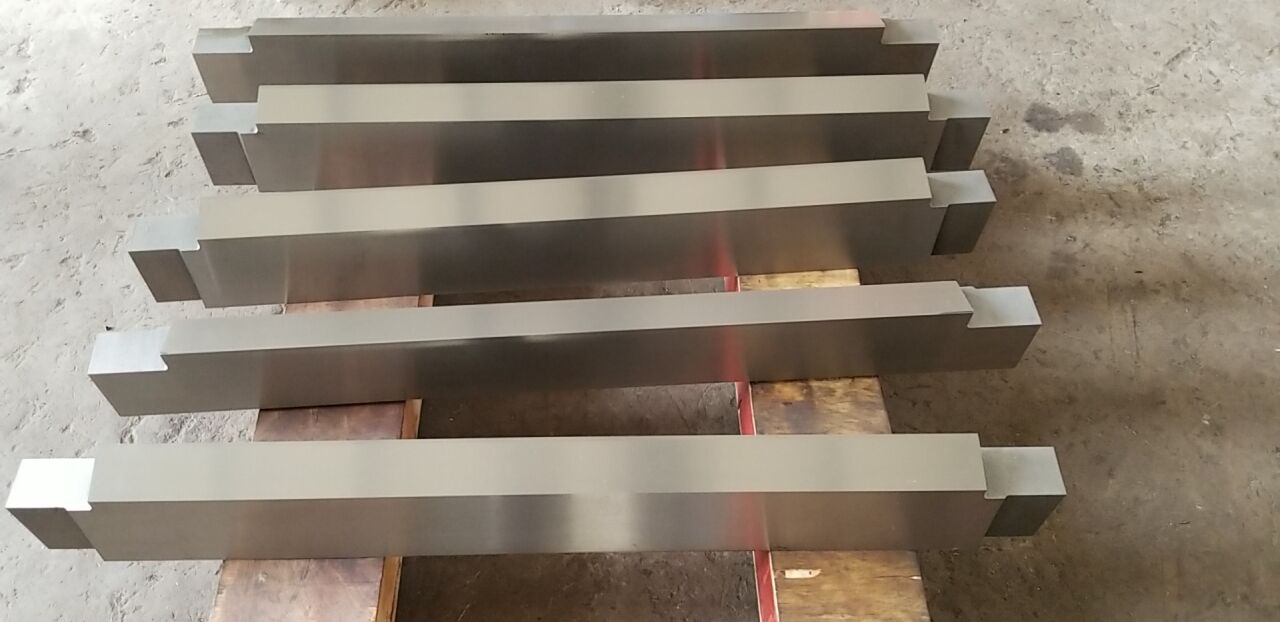
Are Baitian bending moulds compatible with automated machines?
Yes, our CNC bending moulds are designed for high compatibility with various press brake models.
Can these shear blades handle high-temperature cutting?
Our metallurgical cutting tools perform exceptionally well at temperatures up to 1150°C.